


Product List

- News Center:
- Home>
- News Center>
- Company News>
- News Details
Hot Product | H-Ala-AMC ∙ TFA: Application of an Aminopeptidase Fluorogenic Substrate in Microbial Identification
2026/10/16 16:30:20 Browse volume(20)H-Ala-AMC ∙ TFA
I. Starting from Fluorescence Signal to Explore Aminopeptidase Detection Methods

In fluorescence detection method development, substrate selection not only affects whether the target enzyme can react, but also influences the subsequent signal readout method and experimental design. For aminopeptidase-related research, H-Ala-AMC ∙ TFA provides a substrate option based on the AMC fluorescent reporter group.
By setting appropriate reaction conditions and combining fluorescence observation or instrument readings, researchers can analyze the hydrolytic activity of related enzymes. This approach can be used both for basic enzymatic experiments and provides a raw material reference for the development of microbial fluorescence detection systems.
II. How Does H-Ala-AMC ∙ TFA Generate a Fluorescence Signal?
H-Ala-AMC ∙ TFA's role can be understood from two key parts of its molecule.
The L-alanine part is related to enzyme substrate recognition, while AMC carries the fluorescent reporting function.
When an aminopeptidase with corresponding substrate recognition ability hydrolyzes the bond between L-alanine and AMC, it releases AMC with fluorescent properties, and the fluorescence signal of the system changes accordingly. In experiments, researchers can monitor the reaction process with a fluorescence instrument and analyze substrate hydrolysis, thereby evaluating related aminopeptidase activity.
Unlike merely observing whether a color change appears after the reaction, fluorescence detection can also record signal changes over a period of time, providing data basis for comparing enzyme activity performance under different samples or reaction conditions.
For microbial testing-related research, H-Ala-AMC ∙ TFA can be used for enzyme activity analysis in solution systems, and public technical materials have also explored its application in microbial culture systems. The specific detection method to be used needs to be determined in combination with research objectives, sample characteristics, and experimental conditions.
III. From Enzyme Activity Detection to Fluorescent Culture System: Application Exploration of H-Ala-AMC ∙ TFA
H-Ala-AMC ∙ TFA's application in microbial research is not limited to observing a single enzymatic reaction. Public patent materials show that researchers have used it for detecting microbial alanyl aminopeptidase activity and explored technical solutions for adding it to culture systems and observing microbial enzymatic characteristics through fluorescence signals.
In enzyme activity detection, H-Ala-AMC ∙ TFA can serve as a reaction substrate, helping researchers observe the activity performance of related aminopeptidases and study the effects of different experimental conditions on the reaction. In the development of fluorescent culture systems, it can further evaluate the compatibility between the substrate and culture medium formulation, culture conditions, and signal readout methods, providing a reference for detection method design.
For R&D personnel in microbial testing, culture medium development, and related reagent development, the value of H-Ala-AMC ∙ TFA lies in providing a fluorescent substrate option for related aminopeptidase activity research, providing a raw material basis for enzymatic indicator research and fluorescence detection method exploration.
IV. Application Scenarios of H-Ala-AMC ∙ TFA
1. Rapid Fluorescence Identification of Gram-Negative Bacteria
Utilizing the difference in L-alanine aminopeptidase activity between some Gram-negative and Gram-positive bacteria to distinguish Gram-negative from Gram-positive bacteria. Applied in microbial primary screening, food safety testing, environmental microbial monitoring, and automated identification system development.
2. Development of Microbial Identification Culture Media
Used to develop Gram-negative/positive bacteria differential culture media, fluorescent identification culture media, and multi-target selective culture media by utilizing differences in L-alanine aminopeptidase activity among microorganisms.
3. Aminopeptidase Activity Detection and Inhibitor Screening
Used for aminopeptidase activity detection and inhibitor screening. Applied in high-throughput screening of aminopeptidase inhibitors, development of protease detection kits, and enzyme kinetics research.
V. Product Information: H-Ala-AMC ∙ TFA
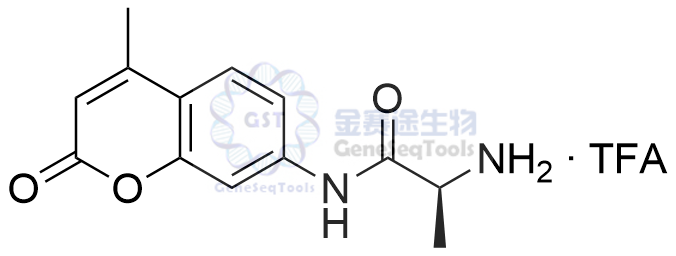
Chinese name: L-Alanine-7-amido-4-methylcoumarin trifluoroacetate salt
English name: L-Alanine 7-amido-4-methylcoumarin trifluoroacetate salt
Abbreviation: H-Ala-AMC ∙ TFA
CAS No.: 96594-10-4
Molecular Formula: C15H15F3N2O5
Molecular Weight: 360.29
Specification: 1 g / 5 g / 25 g (custom packaging supported)
Appearance: off-white crystalline powder
Catalog No.: G04050022
Stock: In stock
Signal: Blue fluorescence
H-Ala-AMC ∙ TFA is a fluorescent substrate used for related aminopeptidase activity research.
Other salt forms:
According to different experimental systems and product form requirements, GeneSeqTools Bioscience & Technology can provide H-Ala-AMC ∙ TFA form and related products such as hydrochloride, making it convenient for R&D personnel to choose in combination with experimental design.
• CAS: 77471-41-1, H-Ala-AMC
• CAS: 204909-39-7, H-Ala-AMC · HCl
VI. From Substrate Characteristics to Application Compatibility: Core Advantages of H-Ala-AMC ∙ TFA
✅ Clear target reaction, suitable for related aminopeptidase activity research
H-Ala-AMC ∙ TFA can be used for related alanyl aminopeptidase activity detection, providing substrate support for microbial enzymatic characteristic analysis and related enzyme activity research, making it convenient for R&D personnel to carry out experimental design around the target enzyme.
✅ AMC fluorescent reporter group, supporting enzymatic reaction signal readout
After hydrolysis by related enzymes, the substrate releases the AMC fluorescent reporter group, which can be combined with fluorescence observation or instrument detection to analyze reaction signals, providing raw material support for enzyme activity determination and fluorescence detection method development.
✅ Can be used for compatibility evaluation of various R&D systems
H-Ala-AMC ∙ TFA has public technical materials for microbial-related enzyme activity detection and fluorescent culture system exploration, and can provide reference for microbial testing R&D, culture medium formulation design, and related enzymatic research. Specific applications still need to be verified in combination with target microorganisms and experimental conditions.
✅ In-stock supply, supporting customized packaging
H-Ala-AMC ∙ TFA is available in stock, with specifications covering 1 g, 5 g, and 25 g, and supports customized packaging, making it convenient for customers to choose flexibly according to actual R&D usage and meet different experimental scale and procurement needs.
VII. Selection and Application of H-Ala-AMC ∙ TFA: Common R&D Questions
Q1: H-Ala-AMC ∙ TFA What does it detect? Why can it be used for Gram-negative bacteria identification?
A: H-Ala-AMC ∙ TFA is used to detect L-alanine aminopeptidase activity. Because some Gram-negative and Gram-positive bacteria differ in this enzyme activity, in an appropriate detection system, Gram-negative bacteria can hydrolyze the substrate and release the AMC fluorescent group, assisting in distinguishing Gram-negative from Gram-positive bacteria through fluorescence signals.
Q2: H-Ala-AMC ∙ TFA Can it only be used for qualitative detection? Can it be used for quantitative analysis of enzyme activity?
A: H-Ala-AMC ∙ TFA can be used to observe fluorescence reactions and also for related enzyme activity analysis. Under appropriate experimental conditions, the enzymatic reaction rate can be analyzed by monitoring changes in fluorescence signal over time. If quantitative analysis is required, an analytical system should be established in combination with instrument parameters, reaction conditions, and appropriate calibration methods.
Q3: Compared with traditional Gram staining and chromogenic culture media, what are the differences?
A: H-Ala-AMC ∙ TFA can be used for enzyme activity detection in liquid systems, while traditional Gram staining and chromogenic culture media are mainly used for observing colony morphology and color. The two are used at different stages and can be combined. Under appropriate conditions, H-Ala-AMC ∙ TFA can be used for rapid primary screening, and chromogenic culture media can be used for subsequent isolation and confirmation.
Q4: H-Ala-AMC ∙ TFA What are the differences from L-Leu-AMC and L-Ala-pNA?
A: H-Ala-AMC ∙ TFA and L-Leu-AMC use L-alanine and L-leucine respectively as substrate recognition-related parts, and can be used to study different aminopeptidase substrate preferences. L-Ala-pNA is a chromogenic substrate, mainly reading reaction signals through absorbance changes; H-Ala-AMC ∙ TFA is a fluorescent substrate, analyzing reactions through fluorescence signals. The specific choice needs to be determined in combination with the target enzyme, detection system, and instrument conditions.
Q5: H-Ala-AMC ∙ TFA Can it be used for automated microbial identification system development?
A: It can be evaluated as a candidate substrate for related liquid biochemical detection or fluorescence detection modules. During R&D, substrate compatibility and detection performance verification can be carried out in combination with target enzyme activity, reaction system, signal readout conditions, and result interpretation requirements.
Q6: H-Ala-AMC ∙ TFA How to dissolve it? How to determine working concentration and pH?
A: It is recommended to first prepare a concentrated stock solution with DMSO or DMF, then dilute into the working system. The working concentration needs to be optimized in combination with enzyme activity level, incubation time, instrument sensitivity, and detection system. AMC fluorescence is affected by pH and is stronger under slightly alkaline conditions; it is recommended to use it in a neutral to slightly alkaline buffer system.
Q7: What information should be noted when purchasing H-Ala-AMC ∙ TFA?
A: It is recommended to confirm the product name, CAS number, chemical form, specification, and actual R&D use, and check relevant quality documents according to experimental requirements. GeneSeqTools Bioscience & Technology provides H-Ala-AMC ∙ TFA in stock, with specifications including 1 g, 5 g, and 25 g, and supports customized packaging.

Extended Services
Read enzyme activity through fluorescence, making detection signals more evidence-based.
For more "peptidase chromogenic substrates" or customized packaging services, please call +86 13302967066!
GeneSeqTools Bioscience & Technology focuses on providing reliable domestic substitution solutions for gene sequencing, molecular diagnostics, and microbial testing.
For related products such as blood cell dyes and buffer salts, you can view the complete product line and technical specifications at[MedSun Biotechnology Website].

Founded in 2015, it is a high-tech enterprise focusing on microbial testing、 gene sequencing and in vitro molecular diagnostics in the R&D, production, and sales of biochemical reagent raw materials. Committed to providing high-quality biochemical reagent raw materials and professional custom synthesis services, the product portfolio covers more than a dozen categories and nearly a thousand innovative products. Upholding the core philosophy of “customer first, integrity and professionalism”, we serve with dedication to meet customers’ diverse needs in research and testing.

Official WeChat account: Shenzhen GeneSeqTools Bioscience & Technology Co. Ltd.
GeneSeqTools official website: http://www.geneseqtools.com
Hotline: +86 0755-23251735
QQ: 2370561481
Email: sales@geneseqtools.com
Related Links
- · FAQs about Geneseqtools BioTech [2024-07-04]
- · In Stock | Rapid Visual Detection of Cronobacter in Infant Formula Milk Powder: Domestic X-α-Glc Solution [2026-09-18]
- · Double Holiday Approaching: Have You Arranged Your Orders? GeneSeqTools Holiday & Shipping Notice [2026-09-22]
- · Raw Materials as the Foundation, Innovation as the Drive | GeneSeqTools at the 20th Academic Symposium on Microbial Culture Media [2026-09-29]
- · In Stock | Key Raw Material for Salmonella Chromogenic Media: Application Analysis of Magenta-Caprylate [2026-09-30]
- · In Stock | Hard to Tell Colony Morphologies Apart? Butyrate Esterase Detection Adds Another Discriminating Dimension [2026-10-10]
- · In Stock | Salmonella Chromogenic Media Formulation: Why a Blue C8 Esterase Substrate Is Needed Beyond Magenta [2026-10-13]
- · Hot Product | H-Ala-AMC ∙ TFA: Application of an Aminopeptidase Fluorogenic Substrate in Microbial Identification [2026-10-16]
